


Somatic & Energetic Healing
A body-centered framework for regulation, repair, and embodied safety


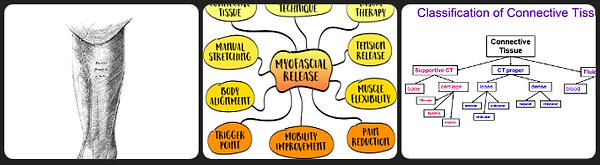
SECTION II — Fascia Work & Release
Overview
Fascia is the connective tissue matrix that permeates the entire body, wrapping muscles, organs, and nerves. Modern research reveals fascia to be sensory-rich, adaptive, and memory-holding, contradicting earlier views of it as inert packing material. Fascial restriction is now recognized as a contributor to chronic pain, limited mobility, postural holding, and stress retention.
Historical Lineage
-
Traditional Bodywork: Massage, rolfing, and structural integration intuitively worked with fascial planes long before imaging confirmed their importance.
-
Modern Anatomy: Imaging technologies in the late 20th century revealed fascia as a continuous system.
-
Trauma Research: Fascia appears to respond to stress with contraction and densification.
How Fascia Release Works
Gentle pressure, slow stretching, and sustained attention hydrate connective tissue, restore glide and elasticity, release held patterns associated with stress or injury. Fascial release often produces emotional discharge, not because emotion is targeted, but because structure and experience are intertwined.
Free External Resources
🔗Fascia Research Society – Open Educational Resources
🔗Gil Hedley – Free Fascial Anatomy Lectures
🔗PubMed Central – Open Access Fascia Studies
SECTION I — Somatic Healing
Overview
Somatic healing is an approach to healing that prioritizes the body as the primary site of memory, regulation, and repair, rather than treating the body as a passive container for psychological processes. It recognizes that stress, trauma, and emotional experience are encoded physiologically and must be resolved through bodily awareness and release. This approach is not new. While the term somatic is modern, body-based healing practices appear across ancient medical systems and ritual traditions. What distinguishes contemporary somatic work is its integration with neuroscience, trauma research, and psychophysiology.
Historical Lineage
-
Ancient Medicine: Greek, Chinese, and Ayurvedic systems treated emotion and physiology as inseparable.
-
Wilhelm Reich (early 20th c.): Introduced the concept of character armor, observing that chronic emotional suppression manifests as muscular tension.
-
Post-War Trauma Studies: Combat trauma revealed that talk-based approaches alone were insufficient.
-
Late 20th Century Somatic Therapies: Practitioners such as Peter Levine formalized trauma-informed somatic models.
How Somatic Healing Works
Somatic healing focuses on interoception (internal bodily awareness), tracking sensation without narrative, restoring the body’s capacity to self-regulate. Rather than reliving trauma, the body is guided toward completion of interrupted stress responses, allowing stored activation to discharge safely.
Free External Resources
🔗Somatic Experiencing International (Free Articles & Videos)
🔗NICABM – Somatic Trauma Education (Free Lectures)
🔗Stanford Letter Project – Body Awareness & Healing

SECTION III — Nervous System Regulation
Overview
Nervous system regulation focuses on restoring balance between sympathetic (activation) and parasympathetic (rest) states, allowing the organism to respond flexibly rather than reflexively.
This section is foundational because no spiritual, psychological, or energetic practice functions well in a chronically dysregulated system.
Historical Lineage
-
Early Physiology: Autonomic nervous system identified in the 19th century.
-
Polyvagal Theory (Stephen Porges): Introduced the role of the vagus nerve in safety, social engagement, and shutdown.
-
Trauma-Informed Care: Emphasized regulation as a prerequisite for processing.
How Regulation Works
Regulation practices increase vagal tone, widen the window of tolerance, restore the capacity to shift states without collapse or overwhelm. This includes orienting to safety, rhythmic movement, vocalization, and slow sensory input.
Free External Resources
🔗Polyvagal Institute – Educational Materials
🔗Nervous System Regulation (Harvard Health)
🔗NIMH – Stress & Regulation Resources


SECTION IV — Breathwork
Overview
Breathwork is one of the most direct and controllable interfaces with the nervous system. Unlike many practices, breath can be voluntarily altered to shift physiological state in real time.
Historically used for spiritual ends, this section focuses on regulatory breath, not trance induction.
Historical Lineage
-
Pranayama (India): Breath as life force regulation.
-
Daoist Breathing: Breath and vitality circulation.
-
Modern Respiratory Science: CO₂ tolerance, vagal stimulation, and autonomic balance.
How Breathwork Works
Slow, nasal, diaphragmatic breathing lowers heart rate, reduces cortisol, and then signals safety to the brain. This makes breathwork a primary stabilization tool, not an altered-state practice.
Free External Resources
🔗Huberman Lab – Breathing & Physiology (Free Content)
🔗Navy SEAL Breathing Techniques (Public Guides)
🔗Buteyko Clinic – Free Educational Resource

SECTION V — Sound Healing (Regulation-Focused)
Overview
Sound healing, when framed responsibly, functions as sensory regulation through vibration and rhythm, not mystical transmission. Auditory input has direct access to the nervous system, bypassing cognitive filtering.
This section explicitly excludes ritual or trance-based sound work, placing sound firmly in the domain of physiological entrainment and soothing.
Historical Lineage
-
Ancient Cultures: Chanting, drumming, and toning used to regulate groups.
-
Military & Clinical Contexts: Rhythm and sound used to stabilize attention.
-
Modern Neuroscience: Frequency and rhythm shown to affect brainwave patterns and autonomic state.
How Sound Regulation Works
Sound influences vagal pathways, auditory processing centers, and rhythmic entrainment of breath and heart rate. Low-frequency, repetitive, predictable sound patterns promote down-regulation and safety.
Free External Resources
🔗NIH – Music Therapy Research (Open Access)
🔗British Academy of Sound Therapy – Free Resources

"We do not need a middle-person or hierarchy to access the divine. The kingdom is within. We are each a fractal of the divine, here to experience being human."
-from our Ethos