


Hecate
LIMINAL SOVEREIGN WITNESS KEEPER OF THE FLAME

How to Read This Page
Hecate exists at the intersection of ancient theology, folk magic, suppressed feminine power, and living devotion. This page intentionally holds multiple layers.
-
Historical and archaeological material reflects what can be reasonably inferred from early texts and artifacts.
-
Mythological material draws from Greek, Anatolian, and broader ancient Mediterranean traditions.
-
Esoteric and magical material reflects the Greek Magical Papyri, Chaldean Oracles, mystery traditions, and initiatory streams.
-
Speculative and devotional traditions are included clearly and respectfully — not dismissed, not asserted as singular truth.
Hecate resists tidy categorization. She always has. That is not a flaw. It is her nature.
Origins: Before Greece
To understand Hecate fully, we must go back further than the Greek pantheon. Most scholars believe Hecate’s origins are pre-Greek; likely rooted in ancient Anatolia, the region of modern-day Turkey, where she may have been worshipped as a sovereign goddess long before she was absorbed into the Hellenic mythological framework. The name itself resists easy etymology. Proposed origins include a connection to the Greek hekatos, meaning “far-reaching” or “far-shooting,” but the name’s full resonance likely predates Greek linguistic interpretation.
Her earliest iconography does not show a shadowy figure of the underworld. It shows a powerful, singular goddess; fully realized, holding dominion across multiple realms. She was not a minor goddess who crept to the margins. She arrived already whole.
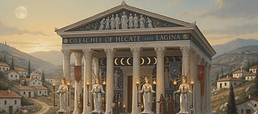
The city of Lagina, in what is now southwestern Turkey, was home to one of the most significant ancient sanctuaries dedicated to Hecate, the Sanctuary of Hecate at Lagina. This was not a small local cult. It was a major religious center with its own festival calendar, priesthood, and elaborate ritual processions. Here she was venerated as a protector of the city and a goddess of profound civic and sacred importance.
This matters. The later image of Hecate as a frightening goddess haunting graveyards at the edges of civilization is a distortion, one that occurred deliberately over centuries. Before that distortion, she stood at the center.
Hesiod’s Hecate: The Full Goddess
The earliest surviving literary portrait of Hecate in Greek tradition is also, paradoxically, one of the most generous. In his Theogony, written around 700 BCE, the poet Hesiod presents Hecate not as a cthonic specter but as an extraordinarily honored goddess, one Zeus himself holds in high regard.
Hesiod’s Hecate is a Titan-born goddess, daughter of Perses and Asteria, who retains her full honors even after the Olympians rise to power. This is significant. Most Titans were displaced, diminished, or imprisoned in the Olympian reorganization. Hecate was not. She kept her portion.
And her portion was vast.
According to Hesiod, Hecate holds power across three realms: the earth, the sea, and the starry heavens. She bestows victory on warriors, wealth on those who seek her favor, good fortune on fishermen, abundance on farmers, and wisdom on those who seek knowledge. She is present at athletic games, at assemblies, and at the side of those who petition the divine.
She is nurse to the young. Protector of those who call on her. Keeper of transitions.
Hesiod’s Hecate is not feared, she is sought. She is generous, multivalent, and cosmically significant. A goddess who touches every aspect of human life and holds the blessing of the highest powers in heaven. This is the original Hecate. She did not begin as a goddess of darkness. She began as a goddess of everything.
Keeper of the Crossroads: Liminality as Sacred Doctrine
Of all Hecate’s domains, it is the crossroads that has become her most enduring symbol, and for good reason. The crossroads is not merely a geographic location. It is a theological one.
In ancient Greek understanding, the crossroads represented the point where worlds intersect: the known and the unknown, the living and the dead, the past and all possible futures. It was a place that belonged fully to no single realm, which made it sacred. Ordinary rules did not apply there. Ordinary perception was insufficient.
Hecate governs all such in-between places: the threshold of a door, the moment between sleeping and waking, the breath between life and death, the season between summer’s fullness and winter’s descent. She holds the liminal, those spaces that resist categorization, as her particular domain.
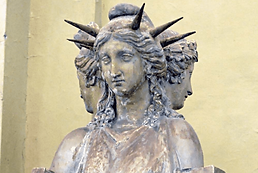
Her epithet Propylaia means “she who stands before the gate.” Household shrines to Hecate, called Hekataion, were commonly placed at doorways throughout ancient Greece; not to ward off evil, but to mark the threshold as sacred, and to ask her blessing on those who crossed it.
This understanding of liminality is not superstition. It is sophisticated theology. Liminal space is the space of transformation. It is where initiation happens, where identity shifts, where the old self releases and the new one is not yet formed. For those deconstructing from rigid belief systems, for those in spiritual awakening, for those leaving one world behind and not yet arrived in another, Hecate is the goddess who stands precisely there. Not to rush you through. Not to pull you back. But to hold the space with you, torch in hand, until you are ready to see.
She does not offer certainty. She offers light in the dark.
Psychopomp: Guide of Souls
Hecate’s role in the myth of Persephone is one of the most theologically significant in the Greek canon, and one of the most frequently overlooked.
When Persephone is taken to the underworld by Hades, it is Hecate who hears her cries. It is Hecate who carries torches into the dark to help Demeter search. And when Persephone returns — and continues to return, season after season — it is Hecate who accompanies her, guiding her through the passage between worlds.
This places Hecate in the role of psychopomp: guide of souls through transitions, particularly the transition into and out of the underworld. She is not the ruler of death. She is the one who knows the way. She has walked those passages so many times that she holds the map in her body.
In this role she holds profound kinship with other psychopomp figures across world traditions: Anubis in Egypt, Hermes in later Greek tradition, the Valkyries of Norse mythology. What distinguishes Hecate is that her guidance is not institutional. She does not ferry souls because she was assigned the role. She does it because she knows the terrain, and because she will not abandon those who are lost in the dark.
For practitioners working with death, grief, ancestral healing, or any form of threshold crossing, Hecate is an ancient and deeply present companion. She has been walking between worlds since before the world had a name for what she was doing.
Hecate and the Witches: The Older Inheritance
The connection between Hecate and witchcraft is ancient, but it is not what centuries of demonization have suggested.
In the Greek tradition, Hecate is strongly associated with the practice of pharmakeia: the knowledge of herbs, plants, and their properties for healing, transformation, and magic. This is not sorcery in the lurid later sense. It is sophisticated botanical and spiritual knowledge, the kind held by healers, herbalists, midwives, and wise women across cultures and centuries.
Her mythological lineage reinforces this. In some traditions she is the grandmother or teacher of Medea and Circe — two of the most powerful magical practitioners in Greek mythology, both deeply misunderstood and deliberately vilified by later retellings. The lineage matters. It speaks to a tradition of feminine power transmitted through knowledge and practice, not through institutional authority or inherited rank.
The Greek Magical Papyri, a collection of ritual texts from Greco-Roman Egypt spanning roughly the 2nd century BCE to the 5th century CE, contain extensive invocations of Hecate. These are not fearful texts. They are devotional ones. Practitioners called on her by name, with reverence, requesting her presence, her power, and her guidance. She was not invoked because she was terrifying. She was invoked because she was effective.
This is the inheritance that later patriarchal and ecclesiastical culture worked very hard to reframe.
The wise woman who knew the forest, the herbalist who could ease pain or induce labor, the midwife who stood at the threshold of birth and death, the woman who kept the old rites; these women were practicing something real. Their knowledge was genuine and their connection to the earth was genuine. The Church did not destroy that knowledge entirely. It demonized the women who held it, and it demonized the goddess they served.
Hecate became the face of witchcraft in its most feared form precisely because she was the face of feminine knowledge the Church most needed to suppress.
The Divine Feminine and the Triple Goddess
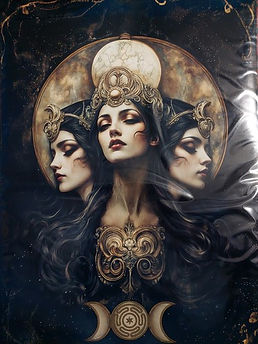
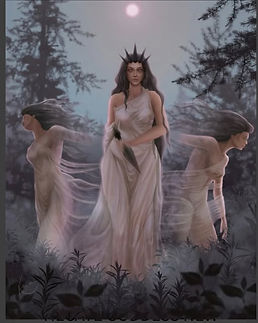
Hecate is one of the earliest and most complete expressions of the Triple Goddess archetype, the understanding of divine femininity as encompassing three phases, three faces, three modes of being. Her triple form, most commonly represented as three figures standing back to back, facing outward in all directions at once, is not merely symbolic decoration. It is cosmological doctrine.
The three faces of Hecate are interpreted differently across traditions, but common frameworks include:
-
Maiden, Mother, Crone- the three phases of the feminine life cycle, each carrying its own wisdom, power, and sacred role.
-
Heaven, Earth, Underworld- the three realms over which Hesiod tells us she holds dominion, suggesting a goddess whose reach is genuinely total.
-
Past, Present, Future- a temporal reading in which Hecate’s sight encompasses all of time at once, making her a goddess of prophecy and deep knowing as much as magic.
The Crone aspect, in particular, deserves reclamation. In cultures shaped by patriarchal values, the Crone became synonymous with ugliness, irrelevance, and threat. Old women with knowledge were dangerous precisely because their authority could not be explained or controlled through the usual mechanisms. Hecate’s Crone face was weaponized into the image of the hag, the witch stirring her cauldron at the edge of the village, to be feared, mocked, or burned.
But the Crone is not a diminishment. She is a fulfillment. She is what wisdom looks like when it has survived enough to know what it knows. She has buried her dead. She has crossed enough thresholds that she no longer fears the crossing. She carries the keys because she has earned them.
Hecate as Crone does not ask for your approval. She already knows what you need.
Demonization and the Long Suppression
The arc of Hecate’s transformation in Western religious history is not subtle. It follows the same pattern seen with other powerful feminine figures; the systematic dismantling of a multivalent goddess into a single, fear-inducing caricature.
In early Greek tradition, she is generous, cosmic, and honored. In later classical sources, she begins to narrow. Her chthonic aspects — her association with the underworld, with ghosts, with the dark of the moon — are progressively emphasized over her celestial and earthly ones. The theological weight shifts. The full goddess begins to be replaced by one face of herself.
By the medieval period, with Christianity consolidating religious authority across Europe, the transformation is nearly complete. Hecate’s name appears in witch trial literature, in demonologies, and in ecclesiastical warnings about pagan practice. Her torches, once symbols of guidance through darkness, are recast as fire in service of evil. Her hounds, once sacred companions, become hellhounds. Her crossroads become places of diabolical pact rather than sacred transition.
This was not accidental. A goddess who governs thresholds, who operates outside institutional oversight, who empowers individuals, especially women, with direct access to spiritual knowledge and power, is precisely the theological model that centralized patriarchal religion cannot accommodate. She had to become frightening so that her devotees would become criminals.
The women who were burned at the stake across Europe between the 14th and 17th centuries were not, in most cases, practicing anything that their grandmothers would have called dark. They were practicing the old knowledge. They were keeping the old rites. They were serving their communities with botanical wisdom, midwifery, and spiritual counsel.
Hecate did not make them dangerous. She made them powerful. That is a different thing entirely.
The Modern Resurgence: Why Now?
Something is happening with Hecate in the contemporary spiritual landscape. Across neopagan traditions, reconstructionist Hellenic practice, eclectic witchcraft, and feminine spirituality movements, she is being called upon with a frequency and depth that suggests something beyond trend.
The resurgence is not coincidental.
We are living through a period of profound threshold-crossing. Old institutions are fracturing. Religious frameworks that shaped entire civilizations are being questioned by the people who were raised inside them. Women and gender-marginalized people are naming the ways that patriarchal spirituality was used as a tool of control. Communities are forming around the reclamation of embodied, experiential, non-hierarchical spiritual practice.
This is precisely Hecate’s domain.
She governs liminal transition. She accompanies souls through dark passages. She holds the torch for those who are between one world and the next. She does not demand a specific doctrine. She asks only that you be willing to see what the light reveals.
For those deconstructing from organized religion, she is a guide who does not require you to rebuild on someone else’s foundation. For those reclaiming witchcraft as a spiritual practice, she is the elder at the root of the lineage. For those doing grief work, shadow work, ancestral healing, or any form of transformation that requires descent before ascent; she has walked those roads since before they had names.
She is also, it should be said, a goddess with a sharp sense of what is true. She carries keys and torches: the keys to open what has been locked, the torches to illuminate what has been hidden. She has no patience for willful blindness, her own or yours.
In this sense she is not a comfortable goddess. She is an honest one. And in this particular historical moment, that may be exactly what is needed.
Her Symbols, Correspondences, and Devotional Practice
Hecate’s symbolism is rich and layered, consistent across millennia of devotion and practice.
Primary Symbols
-
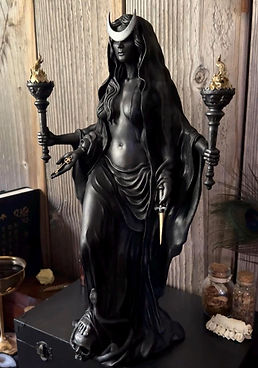
Torches — light carried into darkness; illumination chosen freely rather than granted by an external authority
-
Keys — sovereignty over thresholds; the power to lock and unlock, to open and close; held in multiple traditions as symbols of initiation
-
The triple-form or triple crossroads — her cosmological nature, her sight in all directions
-
The crescent moon and dark moon — she is associated with all lunar phases but particularly with the dark moon, the moment of void before return
-
The serpent — wisdom, transformation, the shedding of what no longer serves
-
Dogs and hounds — her sacred companions; in ancient practice dogs were her heralds and her guardians, their howling understood as her approach
Sacred Plants and Herbs
-
Yew, mandrake, belladonna, and aconite — powerful plants associated with transformation, death, and the between-spaces; these are pharmacologically potent and should be engaged with knowledge and caution
-
Garlic — placed at crossroads shrines as an offering
-
Lavender, mugwort, and wormwood — used in devotional practice and dream work
Devotional Practice In ancient Athens, monthly offerings called Deipnon, or Hecate’s Supper, were left at crossroads on the night of the dark moon. These were not fearful offerings made to appease a threatening spirit. They were acts of reciprocal devotion: food shared with Hecate and the wandering dead, offered in gratitude and relationship.
Contemporary practice varies widely, but common forms include:
-
Crossroads offerings left at any three-way intersection, particularly at night or at the dark moon
-
Altar work with candles (often black, white, or gold), keys, images of her triple form, and personal devotional objects
-
Working with her in threshold moments: beginning new chapters, ending relationships, navigating grief, starting initiatory practice
-
Dream work and divination practiced in her name, particularly in the waning or dark moon
-
Shadow work and inner descent: going into what is difficult, uncomfortable, or suppressed with her torch as companion
She does not require elaborate ritual. She requires honesty.
Why Hecate Matters Here
Hecate is not an ornamental goddess. She is not chosen for aesthetic.
She is a goddess for people who have been through something, who have crossed a threshold and cannot go back, who are navigating the space between who they were and who they are becoming. She is for people who left a religion and are still learning how to exist without the walls. For people doing the slow, non-linear work of reclaiming their own authority. For people who finally realized that the framework they were given was not built to serve them.
She is the goddess of the crossroads because transformation is never tidy. It happens in the in-between spaces, in the dark, in the places no institution wants to claim.
She holds those places. She has always held them. And she has been waiting there with her torches lit, not to frighten you across the threshold, but to walk with you.
Primary Ancient Sources
-
🔗Theogony : Hesiod (c. 700 BCE): contains the most generous and complete early portrait of Hecate in Greek literature
-
🔗Homeric Hymn to Demeter: narrates Hecate’s role as torchbearer and companion to Persephone
-
🔗Greek Magical Papyri (Papyri Graecae Magicae): Greco-Roman ritual texts with extensive Hecate invocations
-
🔗Chaldean Oracles: late antique theurgical texts in which Hecate holds a central cosmological role
-
🔗Argonautica- Apollonius of Rhodes: Medea’s invocation of Hecate
-
Works of Sophocles and Euripides: further mythological context
Secondary and Scholarly Resources
🔗Hecate Liminal Rites- Sorita d’Este and David Rankine: comprehensive scholarly and devotional study
🔗Hecate's Night Ritual Guide- By Witchy Coven
🔗Bearing Torches: A Devotional Anthology for Hekate- community devotional collection
🔗The Covenant of Hekate- international devotional and scholarly community
For Ancient Texts Online
🔗Perseus Digital Library (Greek sources in translation)
She does not rule from thrones. She stands at the crossroads. She carries her own light









Please also check out our Matriarchy Defined page!

"All paths lead to source. We honor plurality without collapsing into relativism. There are many paths, but only one source. No path requires conversion. Curiosity is welcome; persuasion is not required."
-excerpt from our Ethos